Exploring offline AI solutions to help remote farmers with animal welfare.
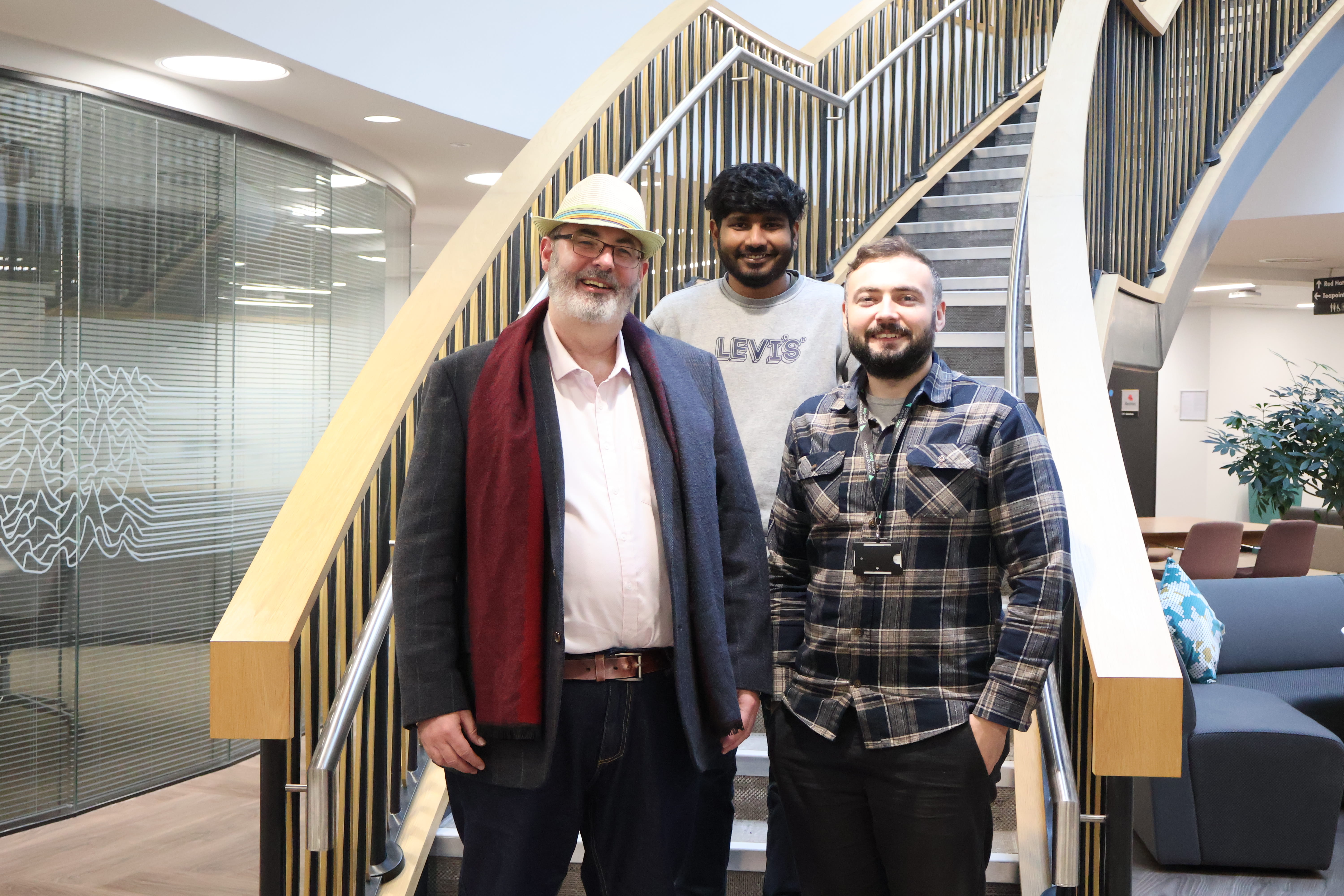
Working with Barefoot Lightning Ltd, the team of Data Scientists at the Hartree Centre North East Hub explored offline artificial intelligence (AI) solutions for Android devices that supports remote farmers and para-vets with animal welfare to increase user engagement.
Challenge
Barefoot Lightning Ltd is a UK based company that is expanding into other markets such as in India and Africa. They wanted to improve user engagement on their Android app, with features designed for para-vets supporting farmers in remote, low-connectivity environments. The primary challenge was to explore the feasibility of using small, resource-constrained AI models that could run locally on a device, avoiding network blackspots and costly cloud services whilst ensuring proprietary animal health data remained secure.
Approach
The Hartree Centre North-East Hub team worked with Barefoot Lightning to explore and develop a proof-of-concept. The project involved an exploratory analysis of suitable small, local Large Language Models (LLMs), inference engines (like LlamaCPP), and fine-tuning transformers like BERT for intent classification.
The core technical approach culminated in a proof-of-concept hybrid routed multi-agent framework. This system uses a fine-tuned, lightweight BERT model to classify a user’s intent and then routes the query to the correct specialist AI agent (e.g., medical, diagnostic, research), providing a reliable tool for managing complex interactions on resource-constrained devices.
Benefits
The proof-of-concept model provides an architecture for deploying a sophisticated, multi-agent AI system on-device. It demonstrates that a lightweight (sub-100mb) intent classifier can accurately route user queries, bypassing the reasoning limitations of smaller, heavily quantised LLMs. The project has also provided a clear set of findings and future recommendations on the trade-offs between model size, quantisation, and capability (like tool-calling). It also delivered a synthetic, private dataset generated offline for training and evaluating the intent classifier.
“The project has been incredible. It’s not only given us the skills to build, but also a tool that worked, and we’ve been able to deploy it and test it in a mobile phone environment, but really it’s been eye opening and it’s completely transformed the team and how we perceive AI.”
“The Hartree Centre North East Hub’s exploratory work has given a few potentially viable strategies to approach our remote environment challenges. By exploring inference and working collaboratively with us on various options and approaches and providing a proof-of-concept utilising smaller models, we can move closer to achieving a capable on-device system to increase engagement of our users. ”
- Dr Simon Holland, Barefoot Lightning Ltd
Further Information
This work was completed as part of one of our collaborative data projects. The projects are up to 12 weeks in duration and give you access to a wide range of expertise across our team of data scientists and data engineers. We will work alongside your team to scope your data science or engineering project, build a prototype solution, and explore options to deploy it within your organisation. You can learn more about them on our webpage here.
If you would like to learn more about the Hartree Centre North East Hub or our collaborative data projects, please get in touch with us at: hello@hartreenortheast.uk

.png)
%20(1).png)


